<?xml version="1.0" encoding="utf-8"?><feed xmlns="http://www.w3.org/2005/Atom" ><generator uri="https://jekyllrb.com/" version="3.10.0">Jekyll</generator><link href="https://ouhaichi.github.io/feed.xml" rel="self" type="application/atom+xml" /><link href="https://ouhaichi.github.io/" rel="alternate" type="text/html" /><updated>2026-02-06T02:00:42-08:00</updated><id>https://ouhaichi.github.io/feed.xml</id><title type="html">Hamza Ouhaichi</title><subtitle>Under construction</subtitle><author><name>Hamza</name><email>hamza.ouhaichi@ltu.se</email><uri>https://www.ltu.se/en/staff/h/hamza-ouhaichi</uri></author><entry><title type="html">I think, therefore I learn!</title><link href="https://ouhaichi.github.io/posts/2024/09/learning/" rel="alternate" type="text/html" title="I think, therefore I learn!" /><published>2024-09-10T00:00:00-07:00</published><updated>2024-09-10T00:00:00-07:00</updated><id>https://ouhaichi.github.io/posts/2024/09/learning</id><content type="html" xml:base="https://ouhaichi.github.io/posts/2024/09/learning/"><![CDATA[<p>Humans start learning before they are even born! When they are born, their learning accelerates exponentiolly. As a super dry sponge or chalk, ready to absorb information. An interesting characteristic is that most of learning happens unconciouslly through trial and error and training. The amazing ability of walking invloves a tramendous amoun of perseverance that most adults would give up on trying if they were to need to relearn it. The ability of walking invloves too many tasks of muscle contractions and coordination that the conscious mind simply cannot handle. There is game that perfectly illustrate how hard walking (or running) is for the concious mind! <a href="https://poki.com/en/g/qwop" target="_blank">QWOP</a>  quirky and notoriously difficult browser game where the player controls the runner’s legs by manipulating their thighs and calves individually. 
The question is: How much of the learning we acquire is a similar (unconscious) learning? The answer is: A lot! There is a bunch of literature explaining how our behaviours are dictated by our unconscious mind which is formed by our daily habits.</p>

<p>When Descartes said “I think, therefore I am!” he was probably surprised and confused after a long process of skeptical thinking. He was doubting everything he thought he knew in the pursuit of a way of finding certainty. Doubting everything including his senses till he reached doubting his own existence and then it came to his mind, that if he is doubting, he is active, he is thinking, which means he must exist. His quote is popular and famous usually without context or proper usage (such a shame). This quote holds its place because its known as a rare self-sufficient statement, and that means it holds true without axioms or assumptions and it does not need external evidence to be verified. Reaching this point is reassuring and disapointing at the same time. It’s like finding a trace of water in the middle of the desert, you get to drink whatever drop is there and hope you will find more.</p>

<p>Who am I? definitly not the body. My body is a vehicle that embodies me. But still that doesn’t answer who am I?</p>

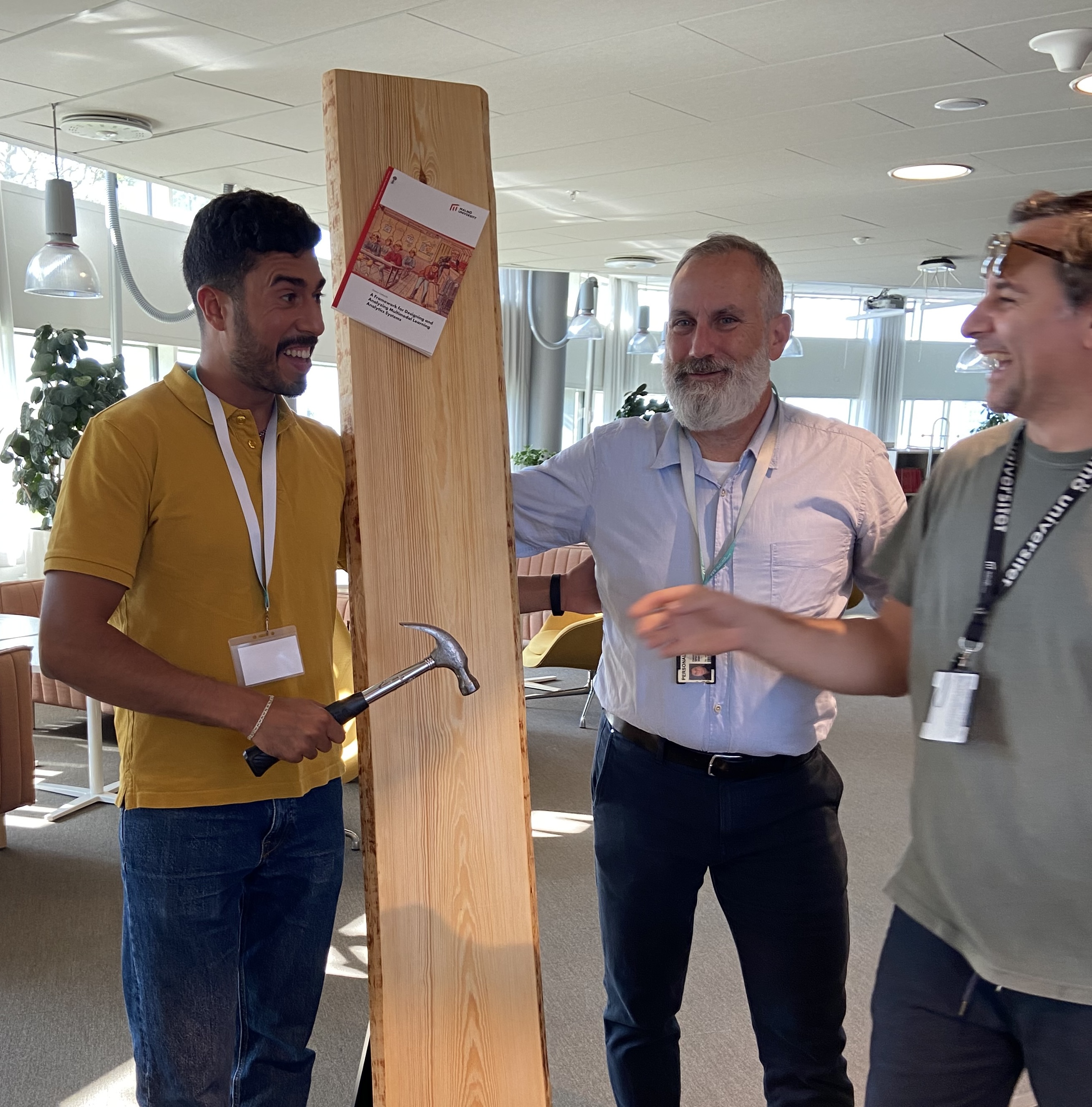
<p>“Still writing…”</p>]]></content><author><name>Hamza</name><email>hamza.ouhaichi@ltu.se</email><uri>https://www.ltu.se/en/staff/h/hamza-ouhaichi</uri></author><category term="thougths" /><summary type="html"><![CDATA[Humans start learning before they are even born! When they are born, their learning accelerates exponentiolly. As a super dry sponge or chalk, ready to absorb information. An interesting characteristic is that most of learning happens unconciouslly through trial and error and training. The amazing ability of walking invloves a tramendous amoun of perseverance that most adults would give up on trying if they were to need to relearn it. The ability of walking invloves too many tasks of muscle contractions and coordination that the conscious mind simply cannot handle. There is game that perfectly illustrate how hard walking (or running) is for the concious mind! QWOP quirky and notoriously difficult browser game where the player controls the runner’s legs by manipulating their thighs and calves individually. The question is: How much of the learning we acquire is a similar (unconscious) learning? The answer is: A lot! There is a bunch of literature explaining how our behaviours are dictated by our unconscious mind which is formed by our daily habits.]]></summary></entry><entry><title type="html">Nailing Ceremony</title><link href="https://ouhaichi.github.io/posts/2024/09/nailing/" rel="alternate" type="text/html" title="Nailing Ceremony" /><published>2024-09-03T00:00:00-07:00</published><updated>2024-09-03T00:00:00-07:00</updated><id>https://ouhaichi.github.io/posts/2024/09/nailing</id><content type="html" xml:base="https://ouhaichi.github.io/posts/2024/09/nailing/"><![CDATA[<p>In Sweden, we nail the printed thesis on a wooden board as a show of making it publicly available before the defence date!</p>

<p><img src="/images/nailing.jpeg" alt="My Image" width="500" height="300" /></p>

<p>I’m grateful for having the best supervisors and colleagues in this journey ❤️</p>

<p>-<a href="https://lnkd.in/dd9brigx">Thesis</a>
-<a href="https://lnkd.in/diinu_jZ">Dissertation defence</a></p>]]></content><author><name>Hamza</name><email>hamza.ouhaichi@ltu.se</email><uri>https://www.ltu.se/en/staff/h/hamza-ouhaichi</uri></author><category term="thougths" /><summary type="html"><![CDATA[In Sweden, we nail the printed thesis on a wooden board as a show of making it publicly available before the defence date!]]></summary></entry><entry><title type="html">Labor</title><link href="https://ouhaichi.github.io/posts/2024/08/Labor/" rel="alternate" type="text/html" title="Labor" /><published>2024-08-16T00:00:00-07:00</published><updated>2024-08-16T00:00:00-07:00</updated><id>https://ouhaichi.github.io/posts/2024/08/labor</id><content type="html" xml:base="https://ouhaichi.github.io/posts/2024/08/Labor/"><![CDATA[<p>There is room in the hospital named the labor room. When a woman is giving birth, we say she is in labor, not because we consider that giving birth is a job but because labor has always been associated with immense suffering.</p>

<p>Don’t spend your life in labor.</p>

<p>-<a href="https://youtu.be/d7u9DbLAa0k?t=843">André Comte-Sponville</a></p>]]></content><author><name>Hamza</name><email>hamza.ouhaichi@ltu.se</email><uri>https://www.ltu.se/en/staff/h/hamza-ouhaichi</uri></author><category term="thougths" /><summary type="html"><![CDATA[There is room in the hospital named the labor room. When a woman is giving birth, we say she is in labor, not because we consider that giving birth is a job but because labor has always been associated with immense suffering.]]></summary></entry></feed>